
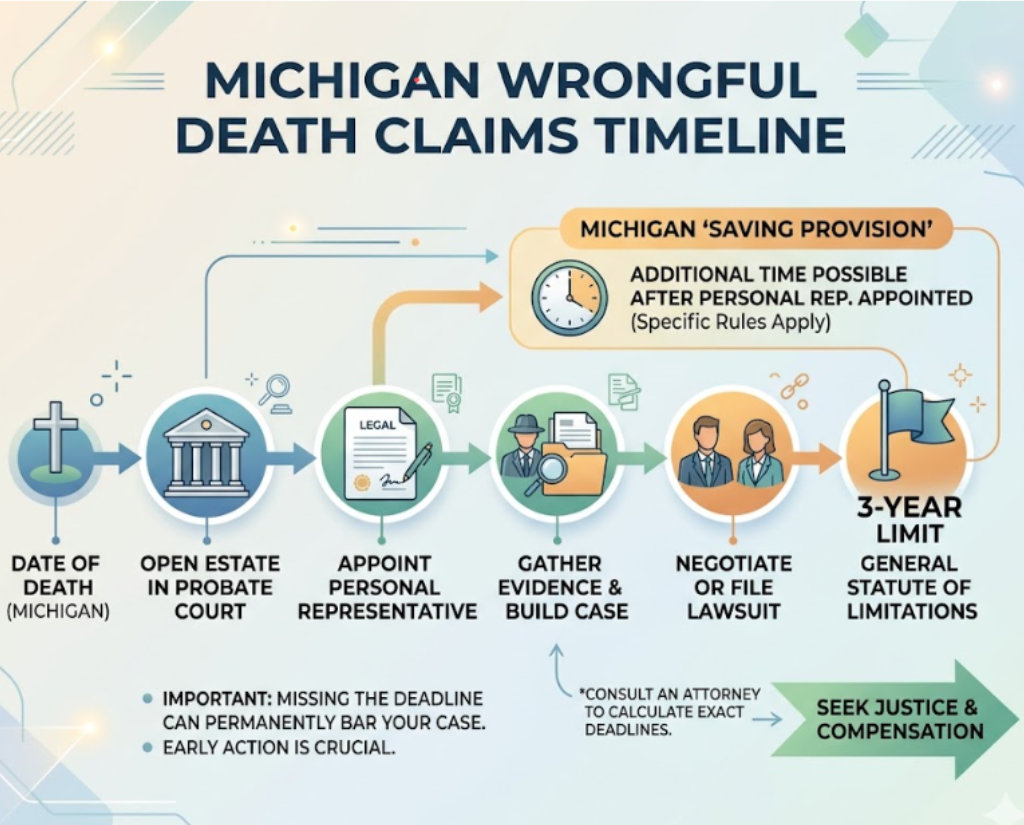
Losing a loved one due to another person’s negligence is one of the most devastating experiences a family can face. In the aftermath of a fatal accident, families are often focused on grieving, making funeral arrangements, and adjusting to life after their loss. During this difficult time, legal deadlines are rarely the first concern. However, one of the most important questions that arises in Michigan wrongful death cases is how long a family has to file a lawsuit under Michigan law.
Michigan law allows families to pursue compensation when a death results from another party’s negligence or wrongful conduct. These claims, however, must be filed within specific legal time limits known as the statute of limitations. If a wrongful death lawsuit is not filed within the required time period, the court may dismiss the case, preventing the family from recovering damages.
Understanding these deadlines is especially important because wrongful death cases involve several legal steps before a lawsuit can proceed. The estate must typically be opened, and a personal representative must be appointed to bring the claim on the estate’s behalf. For families navigating this process while coping with grief, the timing rules can sometimes feel complicated or unclear.
Michigan’s wrongful death laws also contain additional provisions that may affect when a claim must be filed. Understanding these timelines—and how they apply to a particular situation—is an important part of protecting a family’s legal rights after a wrongful death.
The Basic Statute of Limitations for Wrongful Death in Michigan
Michigan law establishes a general deadline for filing wrongful death lawsuits. In most cases, a wrongful death claim must be brought within three years from the date of the person’s death. This time limit is known as the statute of limitations, and it represents the legal window during which a lawsuit must be filed in court.
Statutes of limitations exist to ensure that legal claims are brought within a reasonable period, while evidence is still available and memories of the events remain relatively fresh. If a wrongful death lawsuit is filed after the applicable deadline, the court will typically dismiss the case. When this happens, the family may lose the ability to pursue compensation for the losses caused by the death.
In many wrongful death cases, the three-year timeframe begins running on the date of death, rather than the date of the incident that caused the fatal injuries. For example, if a person suffers severe injuries in an accident but survives for a period of time before passing away, the wrongful death claim will generally be calculated from the date of death rather than the date of the accident itself.
This general three-year rule often applies in situations involving deaths caused by negligence, such as motor vehicle accidents, unsafe property conditions, workplace incidents, or other acts of carelessness. However, wrongful death claims may involve additional legal rules that can affect the timeline, depending on the circumstances of the case.
For that reason, the three-year statute of limitations should be viewed as a starting point rather than the only rule that may apply. Michigan law includes additional provisions that can affect when a wrongful death lawsuit must be filed, particularly when the estate has not yet been opened or a personal representative has not been appointed.
Why Wrongful Death Deadlines Can Be More Complicated Than They Appear
Although Michigan generally provides a three-year statute of limitations for wrongful death claims, the timeline for filing these cases can sometimes be more complicated than it first appears. This is largely because Michigan law requires wrongful death lawsuits to be filed by the estate of the deceased person through a court-appointed personal representative.
Before a wrongful death lawsuit can be filed, the estate typically must be opened in probate court, and a personal representative must be formally appointed. This additional step in the legal process can affect when the claim can move forward. If the estate has not yet been opened, there may be no one with the legal authority to file the lawsuit.
Wrongful death cases may also involve situations in which the injured person survives for a period of time before passing away. In these circumstances, the relationship among the date of injury, the date of death, and the appointment of the personal representative can affect how the filing deadline is calculated.
Because of these overlapping legal steps, determining the correct filing deadline in a wrongful death case is not always as simple as counting three years from the date of death. Reviewing the specific facts of the case and understanding how Michigan law applies are often necessary to determine the proper filing timeline.
Michigan’s “Wrongful Death Saving Provision”
Although Michigan law generally establishes a three-year statute of limitations for wrongful death claims, an additional rule may affect this timeline in certain circumstances. This rule is commonly known as the wrongful death saving provision, and it addresses situations in which a person dies before a legal claim related to their injuries could reasonably be filed.
Under Michigan law, when a person dies before the statute of limitations on the underlying claim has expired, the estate may still have an opportunity to pursue a wrongful death action after a personal representative has been appointed. Because wrongful death lawsuits must be brought by the estate, a probate court must first appoint a personal representative with legal authority to act on the estate’s behalf.
Michigan law recognizes that opening an estate and appointing a personal representative can take time. For that reason, the wrongful death saving provision may allow a lawsuit to be filed within a limited period after the personal representative obtains authority from the probate court, even if the original statute of limitations is nearly expired.
The exact timing rules can become complicated and often depend on several factors, including when the injury occurred, when the death occurred, and when the personal representative was formally appointed. Because these timelines can overlap and interact, calculating the precise filing deadline may not always be straightforward.
For this reason, families should not assume that the standard three-year rule always controls when a wrongful death lawsuit must be filed. Determining the correct deadline often requires careful review of the case facts, the probate timeline, and the applicable provisions of Michigan law.
Why Opening the Estate Quickly Is Important
In Michigan wrongful death cases, the probate process plays an important role in allowing a legal claim to move forward. Because wrongful death lawsuits must be filed by the deceased person’s estate, the estate must typically be opened in probate court. During this process, the court appoints a personal representative who has the legal authority to act on behalf of the estate.
Opening the estate early can help ensure that the legal process begins without unnecessary delays. Until a personal representative is formally appointed by the probate court, no one has the legal authority to file a wrongful death lawsuit. As a result, waiting too long to begin the probate process can delay both the investigation of the claim and the filing of the lawsuit.
Beginning the probate process promptly can also help preserve important evidence. In wrongful death cases, materials such as accident reports, witness statements, medical records, and other documentation related to the incident may become more difficult to obtain as time passes. Taking early legal steps allows attorneys to begin gathering and preserving this information while it is still available.
Opening the estate promptly can also help ensure that the appropriate individual is appointed as the personal representative. Because this person is responsible for filing the wrongful death claim on behalf of the estate and its beneficiaries, appointing the personal representative early can help prevent unnecessary delays later in the legal process.
Michigan law also outlines who may serve as the personal representative responsible for bringing a wrongful death claim on behalf of the estate, which is an important consideration when beginning the probate process.
What Happens If the Deadline Is Missed?
Missing the filing deadline for a wrongful death lawsuit can have serious consequences for surviving family members. Like most legal claims, wrongful death cases are governed by statutes of limitations, and courts generally enforce these deadlines strictly. If a lawsuit is filed after the applicable filing period has expired, the court will typically dismiss the case.
When a wrongful death claim is dismissed for being filed too late, the family may lose the ability to pursue compensation for the losses caused by the death. Courts generally will not evaluate the merits of a claim once the statute of limitations has passed, regardless of how strong the underlying case might be.
Because wrongful death lawsuits must be filed by the estate through a personal representative, delays in opening the estate or appointing the appropriate representative can sometimes contribute to missed deadlines. For this reason, understanding the timing requirements and beginning the legal process early can be important steps in protecting a family’s legal rights.
When there is any uncertainty about the applicable filing deadline, seeking legal guidance as soon as possible is often advisable. An attorney can review the circumstances of the case, identify the relevant deadlines under Michigan law, and help ensure that the necessary legal steps are taken within the required timeframe.
How Timing Relates to Wrongful Death Damages
The timing of a wrongful death lawsuit can play a significant role in whether damages may be recovered under Michigan law. Even when families suffer substantial financial and emotional losses, the ability to pursue compensation depends on filing the claim within the deadlines established by law. If those deadlines are missed, the court may dismiss the case before any damages are considered.
Wrongful death damages are intended to address the many ways a loss can affect surviving family members. These damages may include financial losses such as lost income, medical expenses, and funeral costs, as well as non-economic losses such as the loss of companionship, guidance, and emotional support. In some cases, compensation may also include damages for the deceased’s pain and suffering prior to death.
However, none of these damages can be recovered if the lawsuit is not filed within the applicable statute of limitations. Once the legal filing deadline has passed, courts generally will not evaluate the merits of the case or consider the extent of the family’s losses.
For this reason, understanding the timing requirements of a wrongful death claim is closely tied to protecting a family’s ability to seek damages. Filing within the required timeframe allows the court to review the claim and determine whether compensation should be awarded based on the losses suffered by the surviving family members.
Talk With a Michigan Wrongful Death Attorney Before Deadlines Expire
Understanding how filing deadlines work in Michigan wrongful death cases is an important step in protecting a family’s legal rights. Because these claims are governed by strict statutes of limitations, waiting too long to take legal action may prevent a family from pursuing compensation for the losses they have suffered.
Wrongful death cases often involve several legal steps before a lawsuit can be filed. These steps may include opening the estate and appointing a personal representative through probate court. Because these requirements can affect the timing of a claim, obtaining legal guidance early can help families navigate the process and avoid unnecessary delays.
Speaking with an attorney can help families better understand how Michigan’s wrongful death laws apply to their situation. An attorney can review the case and identify the applicable filing deadlines, and help ensure that the proper legal procedures are followed.
For decades, John Alexander has helped Michigan families navigate wrongful death claims with clarity, care, and experience.
📞 Call 248-290-5600 for a free consultation
📍 Serving families throughout Michigan from our Bingham Farms law firm
There is no obligation and no attorney’s fee unless compensation is recovered. Getting answers early can help families move forward with greater clarity and peace of mind.
National Top 100 Trial Attorney™
National Trial Lawyers Association
Million Dollar Advocates Forum™
Lifetime Member
Michigan Super Lawyer©
Law and Politics Magazine
Top Lawyer
DBusiness Magazine
Lawyers of Distinction Inductee
National Law Journal


0 Comments